
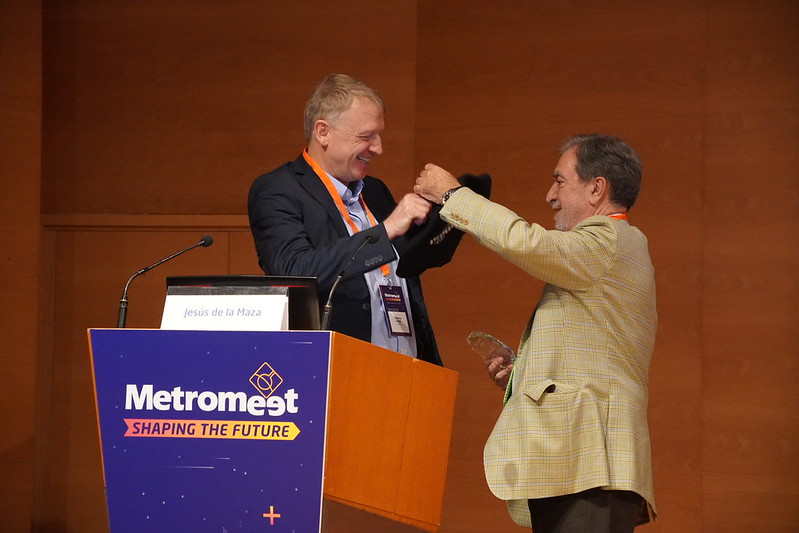
The 21st edition of Metromeet, the international industrial metrology forum, brought together industry and research representatives at the Palacio Euskalduna in Bilbao for two days of discussion on the challenges and opportunities of metrology in the digital age.
Organised by Innovalia Association and sponsored by Innovalia Metrology, the conference once again established itself as a leading meeting point for the metrology community, combining technical rigour with a practical, industry-focused perspective.
Under the theme “Shaping the Future”, Metromeet 2025 focused on how artificial intelligence, digital twins and the digitalisation of metrology processes are transforming industrial operations, enabling more efficient, traceable and sustainable manufacturing.
A Meeting Point for Science, Industry and People
Before the official start of the conference, speakers and committee members enjoyed a guided tour of the Guggenheim Museum Bilbao, the perfect prelude to the event and an opportunity to connect and exchange ideas with professionals from across Europe and the Americas.
On 16 and 17 October, Metromeet featured a programme of tutorials, presentations, technical talks and roundtable discussions, with contributions from experts representing Siemens, the Charlotte Precision Metrology Center, the University of Oslo, Innovalia Metrology and other leading institutions in the fields of measurement and industrial quality.
From AI in Manufacturing to Digital Quality Documentation
The opening session was introduced by Katia Lavin (Innovalia Association), who welcomed attendees and highlighted the importance of continuing to foster collaboration between companies, universities and technology centres to address the challenges of industrial digitalisation.
The first tutorial, delivered by Toni Ventura-Traveset (DATAPIXEL), explored the role of artificial intelligence in modern manufacturing. Ventura-Traveset highlighted the paradigm shift taking place in industrial quality, where AI not only supports inspection but also redefines the role of the operator.
The first presentation track, dedicated to Metrology for Materials and Sustainability, featured a talk by José A. Yagüe Fabra (University of Zaragoza) on the use of X-ray computed tomography (XCT) to evaluate 3D-printed components. His work demonstrated how traceability and measurement uncertainty can be managed comprehensively, even when dealing with complex geometries.
Meanwhile, Dimitris Kyritsis (University of Oslo) presented the Information Modelling Framework (IMF), a model that transforms industrial information into interoperable knowledge graphs, facilitating the development of robust digital twins connected throughout the product lifecycle.
One of the highlights of the conference was the keynote delivered by Thomas Engel (Siemens), entitled “The Digital Transformation of Metrology.” Engel explored the importance of traceability when sharing metrological data, showing how digital certificates and interoperability standards such as the Asset Administration Shell (AAS) are reshaping traceability and information exchange between suppliers, manufacturers and laboratories.
The afternoon continued with the track on artificial intelligence and verification. Lalit Harode addressed the regulatory challenges associated with introducing AI into legal metrological verification, while Ainhoa Etxabarri (Innovalia Metrology) presented a practical approach to integrating measurement directly into the production process, reducing inspection times and improving the reliability of decision-making.
The day concluded with the traditional gala dinner at the Sociedad Bilbaína, where attendees, speakers and sponsors came together for an evening of networking and professional exchange.
From Data to Decision-Making: Digital Twins and Emerging Skills
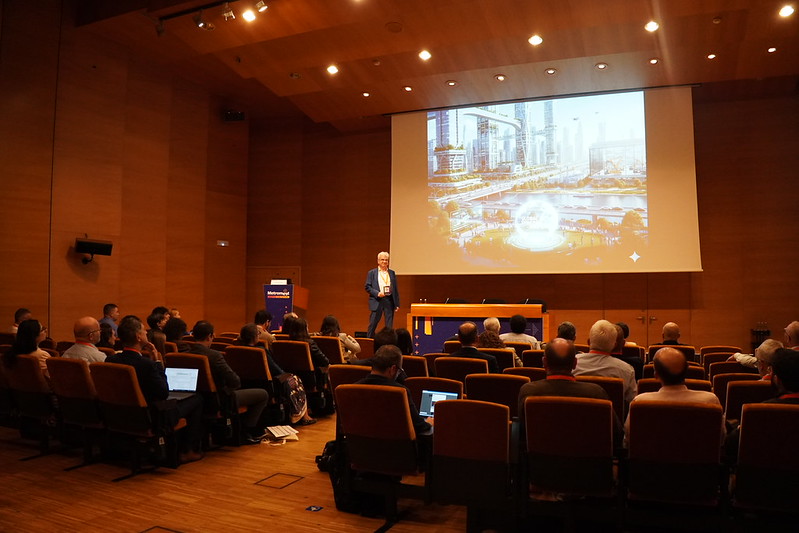
The second day began with the “Decision Rules” tutorial, delivered by Edward Morse (University of North Carolina at Charlotte), which explored the application of decision rules in accordance with ISO/IEC 17025. Morse presented practical examples of how to manage measurement uncertainty and risk, offering valuable tools for laboratories and quality departments.
The morning track, dedicated to From Data to Decisions, opened with Claudio Turrin, who presented ASE, a low-code platform designed to automate testing and quality control processes while ensuring traceability and reducing human error.
Next, Óscar Lázaro (Innovalia Association) delivered the presentation “Trusted Data Exchange for Excellence in Metrology Services,” highlighting the importance of trust and interoperability in data exchange across the metrology ecosystem — a key factor in advancing towards more integrated and collaborative measurement services.
The afternoon track focused on digital twins and metrology robotics. Ahmed Chekh Oumar (Tekniker) presented a metrological digital twin for robotic 3D scanning systems, capable of planning measurements, estimating uncertainty and simulating trajectories before physical execution.
Guillermo González Marín (CFAA-UPV/EHU) closed the session with a study on predicting point intensity in on-machine laser scans, demonstrating how AI models can improve point cloud quality in complex industrial environments, such as the aerospace sector.
The special closing session, delivered by Kyle Stephen (University College London), introduced the explore3DM initiative, an open-access project aimed at making 3D metrology knowledge available worldwide. His presentation highlighted the importance of training and accessibility in addressing the skills gap across the manufacturing sector.
The conference concluded with a roundtable featuring Toni Ventura, Jesús de la Maza and Edward Morse, alongside contributions from the other speakers and attendees. The discussion brought together the key themes explored over the two days, emphasising that artificial intelligence is no longer a technology of the future but an integral part of today’s industry. While AI offers significant transformative potential, its role in manufacturing and dimensional metrology must be carefully defined to ensure rigour, traceability and trust in data.
Combining technical expertise, forward-looking perspectives and close collaboration among participants, Metromeet 2025 reaffirmed Bilbao’s position as an international hub for metrology innovation.